
Public Health in Focus is a newsletter by Public Health Sudbury & Districts to inform our community on the public health issues of the day and is issued following our regular Board of Health meetings.
Words for Thought
September 2026
The value of trusted data in protecting community health
A recent New York Times article highlighted debates surrounding the interpretation of measles data and its role in shaping public health discussions, reinforcing the importance of accurate, evidence-based information when assessing health risks and informing policy.
In public health, data on diseases—how many, in whom, and where—are the foundation of how we approach issues. Unfortunately, that data is now being increasingly politicized in the United States.
Currently, the United States is facing a significant measles outbreak, which started around the same time as the one in Canada last year. The measles outbreak in Canada was stabilized within weeks and then had a long tail of decline to get back to zero infections by early 2026. The United States, over a year and a half in, is seeing more rapid increases now, with the federal public health agency communicating skepticism to the vaccine against it.
Misinformation is one of the critical risks identified in Public Health Sudbury & Districts’ Risk Management Plan. When formally respected sources of information, such as the U.S Centers for Disease Control and Prevention (CDC), begin to question established science and bedrock data, we can expect misinformation to grow. Worse, as the measles outbreak continues in the United States the potential spillover into Canada will put all of our health at risk.
M. Mustafa Hirji MD, MPH, FRCPC
Medical Officer of Health and Chief Executive Officer

Need to do

Back-to-school vaccine checklist
Staying current with recommended vaccines helps protect your child and supports healthy school communities.
Parents and guardians should follow these three simple steps:
- Check your child’s immunization record to make sure all required vaccines have been received.
- Book an appointment with your health care provider or Public Health if your child is due for any vaccines.
- Report new immunizations to Public Health so your child’s record remains complete and up to date.
Keeping immunization records current helps ensure Public Health has accurate information and can contact families if additional vaccines are needed.
Stay up to date with Public Health!
Follow our social media channels devoted to providing engaging news and updates about our programs, services, and clinics. We also have dedicated French accounts!
We’ve updated phsd.ca with a fresh look and improved navigation that is accessible across platforms and devices.
Visit our new website to learn more about local public health services available to you.
Find us @PublicHealthSD or @SantePubliqueSD.
Find us on Facebook, X (Twitter), Instagram, and YouTube. Don’t forget to share this information with friends and family.
Need to know
Our work is grounded by the strategic priorities of impactful relationships, equal opportunities for health, excellence in public health practice, and healthy and resilient workforce. Learn more about how we collaborate to improve population health, support awareness and advocacy, and demonstrate our accountability and effectiveness in our 2024-2028 Strategic Plan.
2025 Financial Report
In 2025, Public Health worked with community partners to support vaccination and infectious disease control, engaged with communities to respond to local health priorities, and continued to invest in actions that help people live healthier lives. Learn more about the agency’s work and how public funds were used to support community health in the 2025 Financial Report.
Highlights of this work are featured in the 2025 Year in Review: Lasting Ripples of Impact.
Cheers to 70 years: Celebrating our past, shaping our future
This month, Public Health Sudbury & Districts is celebrating an important milestone: 70 years of protecting and promoting health across our service area. For seven decades, Public Health has worked alongside residents, communities, partners, municipalities, educators, health care providers, and community organizations to address the health issues that matter most. While much has changed since 1956, our commitment to building healthy communities remains the same.
Over the years, Public Health has played a role in many important public health achievements. From supporting immunization programs that help prevent serious illness, to advancing smoke-free spaces, improving access to preventive oral health services, and supporting children and families through programs such as Healthy Babies Healthy Children, our work has continually evolved to meet changing community needs.
As our communities have grown and changed, so has public health. We continue to learn, listen, and adapt in response to the evolving needs of the populations we serve. We know that the future of public health depends on strong relationships, community voices, and collaborative action. Together with our partners, we will continue building healthier, more equitable communities across our service area.
As we celebrate this milestone, we want to recognize the people who have made it possible. We are grateful to our staff, past and present, our Board of Health, community partners, and the residents we serve. Their dedication, trust, and collaboration have helped shape our story over the last 70 years.
We establish relationships that lead to impactful partnerships, collaborations, and engagement.
Strengthening local partnerships in Espanola
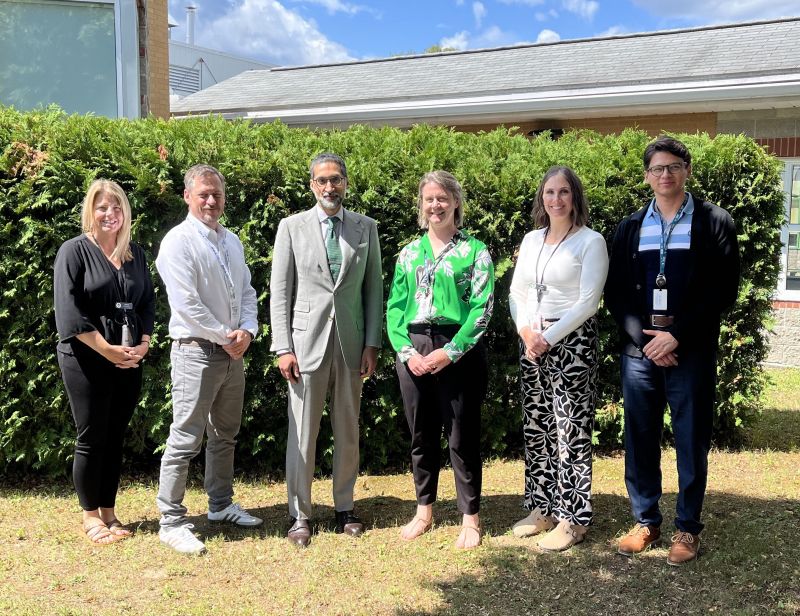
In August, Public Health leadership visited Espanola to connect with staff and local health care leaders (including the Espanola Regional Hospital & Health Centre, photo below) and discuss issues affecting the community. Discussions focused on current health challenges, including the substance use crisis, and opportunities to work together to strengthen supports and services for residents.
Nourishing Students Through Strong Public Health Partnership
Healthy eating starts early. Through the Northern Fruit and Vegetable Program, approximately 27 300 students enjoyed a serving of fruit and a serving of vegetables each week during the 2025–2026 school year. Delivered through a strong partnership between the Ontario Fruit and Vegetable Growers’ Association, the Ministry of Health, local school boards, and Public Health, the program helps students discover new foods while building lifelong healthy eating habits. In early 2026, the program expanded to publicly funded secondary and youth alternative schools, reaching 107 of 109 eligible schools. The program supports health equity, strengthens cross-sector partnerships, and promotes healthy food literacy. Feedback from school coordinators will help shape program enhancements for the 2026–2027 school year.
Promoting water safety across Manitoulin Island
Public Health Sudbury & Districts joined municipalities, emergency services, and other community partners to promote water safety across Manitoulin Island through the Manitoulin Partners for Water Safety. This year’s campaign encouraged residents and visitors to wear a lifejacket or personal flotation device, follow safe practices on and around the water, and help prevent drownings and near-drownings. Resources developed through the initiative will continue to support water safety education and injury prevention efforts in the years ahead.

We strive for health equity by championing equal opportunities for health.
Increasing healthy smiles across Chapleau
To help close a gap in preventive oral health care, Public Health Sudbury & Districts expanded dental screening services in Chapleau daycares, reaching 28 children who were not already connected to the community oral health initiative.
Working in partnership with the Chapleau Daycare Coordinator and Northeastern Public Health, the team identified an opportunity to reach children who might otherwise have missed important preventive care. This fall, these children will also be offered fluoride varnish, a simple and effective treatment that helps prevent tooth decay and supports lifelong oral health. By responding to a locally identified need and reducing barriers to care, this initiative is helping improve access to preventive services, advance health equity, and strengthen partnerships that support the health and well-being of children and families in the community.

We strive for ongoing excellence in local public health practice.
Improving access to immunization services
Public Health recently expanded eligibility for immunization services to improve access for individuals experiencing barriers to vaccination. Services are now available to children and youth aged 2 months to 17 years who do not have a primary care provider, cannot access timely immunization services, or face other barriers to receiving vaccines from community providers. The change responds to community feedback about access challenges, as well as additional capacity created from achieving operational efficiencies through recent investments in technology. By making immunization services more accessible, Public Health is supporting equitable access to care, higher vaccination coverage, and stronger protection for individuals and communities against vaccine-preventable diseases.
Discussing local priorities with federal representatives to advocate for health
Public Health continues to advocate for issues that affect the health and well-being of the communities we serve. In August, Dr. Mustafa Hirji, Medical Officer of Health, met with federal representatives to discuss local priorities, including the substance use crisis, strengthening public health resilience to biological, cyber and airborne risks, and improving indoor air quality in public settings. These discussions help raise awareness of local public health priorities and build support for action at the federal level.
Advancing Indigenous data sovereignty
Indigenous Public Health launched the Indigenous Data Sovereignty Project this summer. This is being undertaken in partnership with Indigenous communities and is led by an Indigenous vendor who was selected through a “request for proposal” process earlier this year.
The project aims to explore approaches to collecting, using, storing, and sharing health data about Indigenous Peoples in ways that respect Indigenous rights, self-determination, and data sovereignty. While guidance in this area remains limited across public health and many other sectors, the project seeks to develop practical tools and processes that support culturally respectful and community-informed approaches to data stewardship and governance.
By working collaboratively with Indigenous communities, the initiative will help strengthen relationships, support reconciliation, and advance more equitable public health practices. The tools and resources developed through the project are expected to support not only Public Health Sudbury & Districts, but also Indigenous communities, and agencies across Ontario and potentially beyond.
See how our work supports a healthier community
Explore our latest activity metrics report and see the wide range of everyday agency services and public health work that impacts your community.